

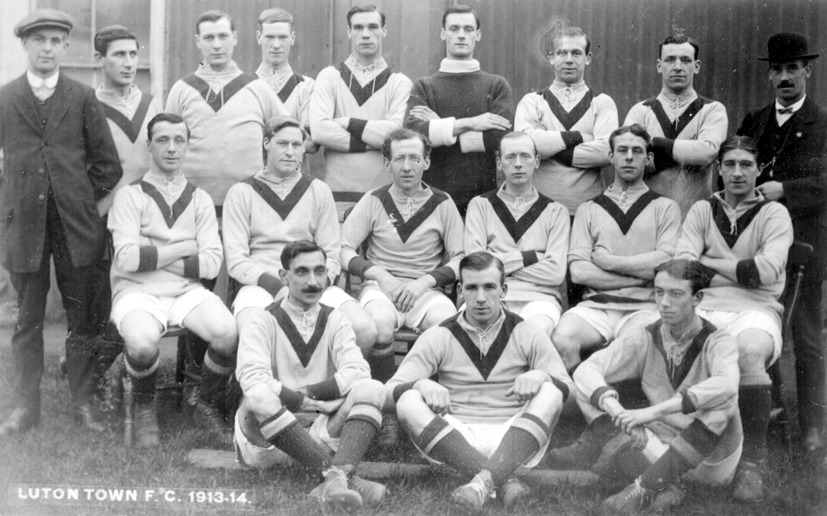
Football prospects for next winter were very briefly summed up by Alderman H. Arnold at the annual meeting of the shareholders of Luton Town Football and Athletic Co Ltd on Monday evening.
"There is nothing to be said as far as our position in concerned beyond what you already know," he said. "Everybody knows we have not been treated too well by the London clubs of the Southern League. The result is that we are certainly left out of competitive matches for a year. There is no final decision come to by the directors as to whether it is desirable to try to arrange a few friendly matches, or to allow things to go by for a year. That will have to be taken into consideration."
According to the balance sheet the wages bill for the year ended April 30th amounted to £2,485 1s 6d, compared with £2,189 16s 3d for the previous 12 months. Travelling expenses and insurance brought this item to £2,933 13s 5d, compared with £2,602 1s 9d for 1913-14. Training expenses, referees and linesmen, police, and league fees appropriated £246 1s 9d, against £147 1s 3d, and the total expenditure amounted to £3,771 13s 3d, as against £3,252 18s 2d.
The gross receipts from the gates were £3,036 7s 9d, against £3,636 17s 4d, and the net receipts to ££2,751 10s 6d, compared with £3,158. The subscriptions from the Supporters' Club were only £99 17s 7d, against £225 for the previous season, but season ticket receipts went up from £131 17s to £186 2s 6d. The loss on the year was £388 10s.
In presenting the balance sheet Alderman Arnold said he had no formal directors' report to lay before the meeting. The effects of the war were so far-reaching that it almost eliminated every other interest - certainly interests of a sporting character. Consequently it had a very important bearing on football in general, and especially on football in Luton at the present time.
So far as the report for the past season was concerned, he thought that, taking all circumstances into consideration, they had come out of it at least as well as could be reasonably expected. Certainly their loss on the year's working was nothing like so great as shown in the balance sheets of some other clubs.
At the beginning of the season the club was somewhat in the dumps, for they hardly knew what would happen, but the military came into town in strong force and certainly saved the situation financially. So far as play was concerned, he thought the directors considered the results fairly satisfactory.
Coming to the balance sheet, Alderman Arnold said there were a few variations from the previous year on which he might comment. Wages and salaries were somewhat in excess of the previous year, and this was entirely due to the success of the previous year. Owing to that success they had to sign on their players and pay close season money for the whole season, as compared with a very small sum paid the year before. That was always the penalty of success.
Men wanted more money and wanted to be signed on almost before the close season started. They had to pay a lot of their players for the whole of the close season, and that accounted for the considerable increase in wages and salaries. This amount was up by £345, but he thought they spent considerably more than that in the close season.
Travelling expenses were fortunately down, as they had not so many journeys into Wales. During the past year the amount was £439 18s 2d, as compared with £567 5s 1d in the previous year, when they received a grant of £100 from te Southern League.
It should also be remembered that last year two teams were run, and only one the previous year, a fact which, taken in conjunction with higher fees payable for Southern League First Division matches, accounted for the increase in fees for referees and linesmen.
The gate receipts, said Alderman Arnold, were considerably down compared with the preceding year - £3,036 7s 9d compared with £3,636 17s 4d. Gates shares and guarantees paid and received were practically the same as before, but there was an increase of £55 from season tickets. The other items were pretty much the same with the exception of subscriptions, which dropped from £225 to £99 17s 7d - affected by the war.
Mr Soper was re-elected as a director, and Mr Walker and Mr Edwards were elected to fill vacancies created by Mr Crick and Mr Woods.
[The Luton News: Thursday, August 26th, 1915]