

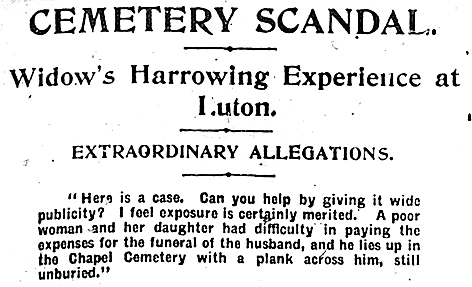
Having taken up the cause of retaining Wardown Mansion for public use rather than as a maternity hospital and the case of a meagre pension agreed by the Board of Guardians for a widow with several children, the Saturday Telegraph (May 24th, 1919) turned its attention to a widow whose husband remained unburied because she could not afford to meet funeral expenses.
On May 22nd the Telegraph received a letter from what it described as “a reliable source” asking for publicity for the newly widowed woman's case. “I feel exposure is certainly merited,” said the letter writer. “A poor woman and her daughter had difficulty in paying the expenses for the funeral of her husband, and he lies up in the Chapel Cemetery with a plank across him, still unburied.”
The Telegraph discovered that the widow's husband had died on Wednesday, May 7th, and was supposed to have been buried on the following Monday, the 12th. She met the Relieving Officer to see if he would meet her half way on the cost of burial, but he said she would have to meet the full cost.
The widow did pay, but when she visited the cemetery on May 18th she went to the grave and found it still not covered in. The situation was the same the following Tuesday, a gravedigger explaining that he had been told to wait for a further burial.
There did not look room for a second coffin to be placed in the grave, said the widow. “I do not think they would have allowed us to put another in if it had been a private grave,” she said.
When a Telegraph representative visited the cemetery on May 22, he found the grave boarded over and a covering of chalk (spread that morning) over the timber.
When the reporter ultimately interviewed Mr H. I. Sell, Chairman of the Cemetery Company Committee, he explained that deep graves were dug and coffins placed in them for a small interment fee. The graves were, however, not filled in completely until they were full.
Immediately a person was buried in a general grave the coffin was covered with a cloth, said Mr Sell, and the top of the grave was boarded over.
The reporter did not accept the explanation that the widow had opened the grave by lifting a loose plank and how she had managed to read the nameplate on her husband's coffin without disturbing the coffin cloth.
Certainly one authority must have a voice in the matter – those charged with public health, said the Telegraph. To leave an occupied grave open during weather so hot as that of the previous ten day was a menace to public health, and not short of a public scandal.
The story produced an angry response from Violet Lewis, a member of the Luton Board of Guardians, in the following edition of the Tuesday Telegraph.
She said: “It is surely left to very few women to have to clamour for their dead to be buried in decency (which sounds more reminiscent of the great plague of London than the present day) or to be forced to protest a fortnight after the reputed interment that the coffin still lies unburied in the grave.
It is useless to argue that this revolting system of “general” graves has always obtained, or that it obtains up and down the country. All such specious arguments carry but heavier condemnation in the train – the bare, glaring, cruel fact stands out in all its stark and callous nakedness – reserved for the very poor, resolving itself, in short, into a question of £sd.
And yet this poor woman had paid for her husband to be buries, and her fee had been accepted. Think what it means to a poor person to raise sufficient money for a funeral.
The “general” grave system, if we take this as an example, is barbarous and insanitary; barbarous because of its wholesale character and lack of decency and respect to the dead. If such practices as this are permitted, no one who buries the dead in a cemetery will feel secure that the graves of dear ones will remain safe or unviolated.
Moreover, it is insanitary, because such a state of affairs as a grave left open for over a week in a town of the size of Luton, or, indeed, in any other place in such weather as we have had these last two weeks, must be a very serious menace to public health.
The fact remains that someone in the first place set up this system that obtains in the Luton Cemetery, and public opinion must let that someone know there are scarcely words strong enough for its condemnation – and that in no uncertain voice.
The responsible person should be brought to book, and this practice of “general” graves abolished for ever as an evil and cruel method of carrying out the last rites of the dead.